Campfire Games for Teens Who Swear They're Bored

Gather round.
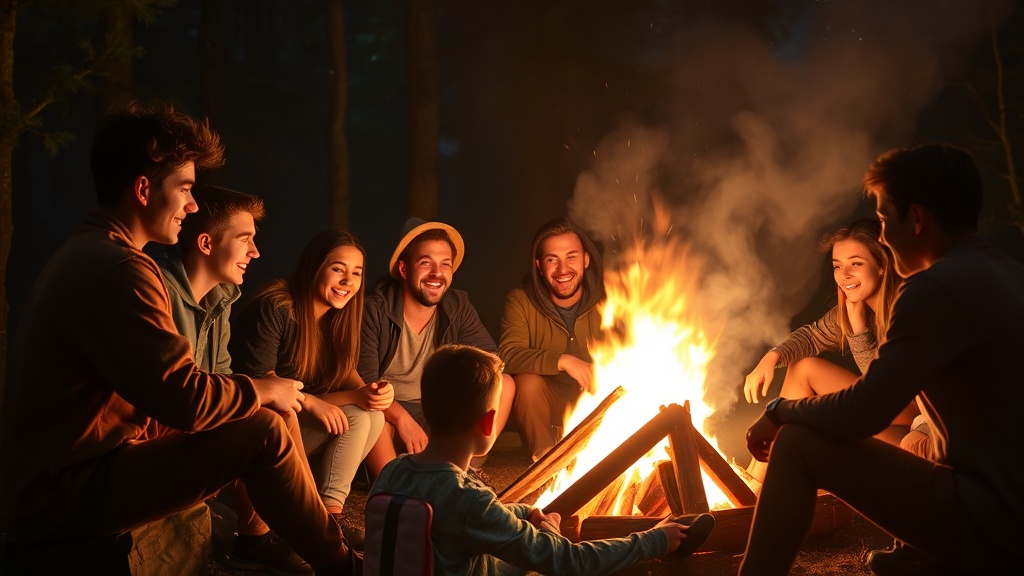
It's that blue-hour moment right before full dark. The fire's finally settled into steady coals, somebody's hoodie smells like smoke already, and my son Jaylen (15, professional eye-roller, part-time philosopher) is doing that thing where he says he's bored while staring straight into the flames like they owe him entertainment.
If you've got teens, you know this moment.
Spring break camping trips are coming up fast, and a whole lot of parents are wondering how to run a no-screen camping activity plan without turning the fire ring into a negotiation table.
Now here's the thing: teens are not "hard to entertain." They're hard to fake out. They can smell forced fun from 40 feet away.
According to Pew Research Center's 2024 U.S. teen tech survey, 46% of teens say they're online "almost constantly." So when you remove screens at camp, you're not just removing a device. You're removing their default social rhythm. You have to offer something that feels real, fast, and a little unpredictable.
That's where these games come in. I've used versions of all three across 12 years of middle school classrooms, 8 summers at Camp Lutherock, and a lot of nights around our backyard pit outside Asheville.
The Golden Rule: Never Announce "Game Time"
Do not clap your hands and say, "Okay everybody, we're playing a game now!"
That sentence has ended more teen participation than any phone battery ever has.
Slide in sideways instead.
Try one of these openers:
- "Settle this for me real quick..."
- "I need a ruling from the fire circle..."
- "Jaylen said this is impossible, and I think he's wrong..."
You're not launching an activity. You're starting a conversation with structure.
Game 1: Hyper-Specific Would You Rather
Regular would-you-rather is fine. Hyper-specific would-you-rather is the move.
Teens shut down vague prompts fast. But give them a weirdly detailed scenario and suddenly they're arguing legal loopholes like tiny campfire attorneys.
Players: 3+
Time: 10-25 minutes
What you need: Nothing
How to play
- One person asks a campfire-themed "would you rather" question.
- The question must include at least one specific condition (weather, time limit, one item, one consequence).
- Everybody answers quickly, then defends their choice.
- Best defense picks the next question.
Prompts that actually work with teens
- "Would you rather cook every meal for a weekend campout with one cast-iron skillet, or one roll of foil and no pan?"
- "Would you rather sleep through a thunderstorm in a hammock with a perfect tarp setup, or in a leaky tent with your best friends?"
- "Would you rather give up your flashlight after dark, or your hoodie below 45 degrees F?"
- "Would you rather be in charge of firewood all weekend, or dishes for twelve people?"
- "Would you rather tell one scary story to strangers, or sing one song in front of your whole campsite?"
Why this works
It doesn't feel like a "kid game." It feels like a debate where they get to be funny, dramatic, and low-key brilliant. It also brings quieter teens in, because there's no pressure to perform a whole speech.
Game 2: Contact
If your group likes words, this one locks people in.
Contact is a word-guessing game that rewards focus, shared references, and quick thinking. It looks slow for about two minutes, then suddenly everybody's leaning forward.
Players: 4+
Time: 15-30 minutes
What you need: Nothing
How to play (campfire version)
- One player is the clue-giver and thinks of a word.
- They announce the first letter only.
- Other players ask for clues indirectly by saying definitions of words that could fit that letter.
- If two guessers think they know the same word from a clue, they say "Contact!" and count down: "3...2...1..." then say their guess together.
- If they match and it's not the clue-giver's secret word, the clue-giver must reveal the next letter.
- Keep going until someone gets the full word.
Example round
- Secret word starts with B.
- Someone says: "A giant mammal with curved horns."
- Two players think "bison," call "Contact," and say it together.
- If clue-giver's word wasn't "bison," they must reveal the next letter.
Why teens love it
It rewards inside jokes and shared knowledge without requiring everyone to be loud. The "contact" countdown creates that little adrenaline hit teens secretly enjoy.
I'm not gonna lie, some of my best campfire moments with Jaylen have happened in dead-serious Contact rounds where everybody acts like the fate of civilization depends on one letter.
Game 3: One-Word Story (Accelerated)
You've probably seen one-word story before. The accelerated version is where the magic happens.
The first minute feels awkward. Then pace increases, everybody starts laughing, and the "too cool" mask drops.
Players: 4+
Time: 8-20 minutes
What you need: Nothing
How to play
- Sit in a circle.
- Pick a story starter: "At midnight, the fire went out and..."
- Go around, one word per person.
- First round: normal speed.
- Second round: no pauses longer than one second.
- Third round: fast pace plus one optional "plot twist" token per player.
Acceleration rules that make it fun
- If someone stalls, the group counts "fire...fire...fire..." and play continues.
- If the story gets stuck, anyone can say "spark" to reset with one new sentence starter.
- End when everyone's laughing too hard to keep rhythm.
Why this works around a fire
Firelight already puts people in story mode. This game channels that energy fast and breaks down self-consciousness without singling anyone out.
As a former English teacher, I love this one because it quietly teaches listening, pacing, and collaboration. As a dad, I love it because it gets teens off autopilot and into the moment.
Quick Host Notes for Parents and Group Leaders
If you're trying to run family campfire games with teens, keep these in your pocket:
- Start with the loudest skeptic. Give them first choice or first prompt. Ownership lowers resistance.
- Keep rounds short. Teens stay in when there's momentum.
- Don't force full participation. Let them watch one round; most jump in naturally.
- Use real stakes. Winner picks tomorrow's trail snack, playlist, or breakfast duty partner.
- End early on purpose. Stop while energy is high so they ask for "one more."
Safety + Presence (Always)
- Keep seating a safe distance from open flame.
- No roughhousing near the ring.
- If there's a fire ban, honor it. No exceptions.
- Phones-down works best when adults follow it too.
And yes, no screen camping activities are easier when grown folks aren't secretly checking notifications every five minutes.
The Real Win
The goal isn't to prove teens can "survive without phones." The goal is to give them a better alternative for one hour: laughter, friendly chaos, and that rare moment where everybody's fully in the same place.
Last weekend Jaylen started the night with "this is gonna be boring."
Forty minutes later, he was arguing that he could absolutely cook for six people with only foil, a headlamp, and "good instincts" (debatable).
That's a win.
Gather round, throw one of these games into your spring break trip, and watch what happens when the fire gets low and the circle gets loud.