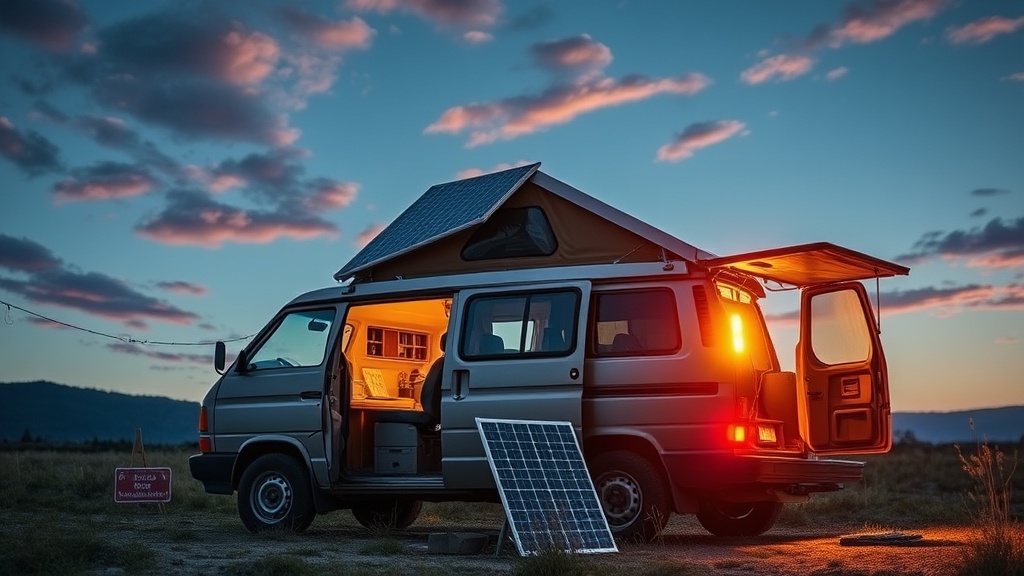
How to Set Up a Reliable Solar Power System for Your Van

A van sits parked in a shaded canyon in Zion National Park. The driver reaches for the laptop to finish a few lines of work, only to find the screen dead. Despite having a full battery from the night before, the internal lights are dim, and the small 12V fridge has stopped humming. The culprit isn't a broken component, but a solar system that was undersized for the cloudy weather and the high energy draw of the electronics. This guide explains how to design and install a reliable solar power system for your van so you can avoid unexpected power failures during your road trips.
Building a solar power system is about more than just buying a panel and sticking it to your roof. It requires a fundamental understanding of how energy moves from the sun to your devices. A reliable system consists of four primary components: solar panels, a charge controller, a battery bank, and an inverter. By calculating your specific energy needs and matching them with the right hardware, you can ensure your lights stay on and your fridge stays cold even when the weather turns.
Step 1: Calculate Your Total Energy Consumption
Before you purchase a single wire, you must determine your daily Watt-hour (Wh) consumption. Most beginners make the mistake of looking only at Amps, but calculating Watt-hours provides a much more accurate picture of your needs. You need to list every device you plan to run, its voltage, and how long it will be used each day.
For example, consider a typical setup in a Sprinter or Ford Transit van:
- 12V Compressor Fridge (e.g., Dometic CFX3): 40W average draw over 24 hours = 960Wh
- LED Lighting (3 bulbs): 10W total for 5 hours = 50Wh
- MaxxAir Fan: 25W for 8 hours = 200Wh
- USB Phone Charging: 10W for 4 hours = 40Wh
- Laptop (via Inverter): 60W for 2 hours = 120Wh
In this scenario, your total daily consumption is 1,370Wh. To ensure reliability, you should always add a 20% buffer to account for efficiency losses in the wiring and the charge controller. Therefore, you should aim for a system capable of providing roughly 1,650Wh per day.
Step 2: Selecting Your Battery Bank
The battery bank is the heart of your van's electrical system. While traditional Lead-Acid or AGM (Absorbed Glass Mat) batteries are cheaper upfront, they are heavy and have a limited Depth of Discharge (DoD). If you regularly drain an AGM battery below 50%, you will significantly shorten its lifespan. For modern van life, Lithium Iron Phosphate (LiFePO4) batteries are the industry standard.
LiFePO4 batteries, such as those made by Battle Born or Renogy, offer several advantages:
- Higher Depth of Discharge: You can safely use up to 80-90% of the capacity without damaging the cells.
- Weight Efficiency: They are much lighter than AGM batteries, which is crucial for maintaining your van's payload capacity.
- Faster Charging: They can accept a higher current, allowing your solar panels to replenish the bank more quickly during peak sunlight hours.
If your daily consumption is 1,650Wh, a 100Ah 12V lithium battery (which holds approximately 1,280Wh) will not be enough for a single day of heavy use. You would need at least a 200Ah lithium bank to ensure you have enough reserve power for cloudy days or nights when you are using the fan and lights extensively. If you find your power levels are consistently low, you may need to investigate why your battery is dying faster than expected and upgrade your capacity.
Step 3: Choosing Solar Panels and Mounting
Solar panels convert sunlight into DC electricity. For van builds, you generally choose between rigid monocrystalline panels or flexible panels. Rigid panels are more durable and efficient, making them ideal for roof-mounted installations on vehicles like the Mercedes Sprinter or Ram ProMaster. Flexible panels are lighter and can follow the curves of a van roof, but they tend to degrade faster due to heat buildup.
To determine how many panels you need, divide your daily target (1,650Wh) by the average number of "peak sun hours" in your travel destination. If you are traveling through the high desert of Utah, you might get 6 hours of peak sun. If you are in the Pacific Northwest, you might only get 3.
The Math: 1,650Wh / 5 hours of sun = 330 Watts of solar. To be safe, a 400W solar array would be a robust choice for this setup.
When mounting, ensure the panels are placed where they won't be shadowed by roof racks, AC units, or vent fans. Even a small shadow over a single cell can significantly drop the output of the entire panel. If you are parked in a wooded area or a canyon, your solar production will drop drastically. Always check why your campground site selection matters, as a shaded site can render even the best solar system useless.
Step 4: The Charge Controller and Inverter
The solar panels cannot connect directly to the battery. The voltage coming from the panels fluctuates constantly based on sunlight intensity, which would damage your batteries. You must use a Maximum Power Point Tracking (MPPT) charge controller. An MPPT controller is more expensive than a standard PWM (Pulse Width Modulation) controller, but it is much more efficient because it optimizes the voltage and current to extract the maximum power from your panels.
Next, you need to decide if you need an inverter. An inverter converts the 12V DC power from your batteries into 110V/230V AC power, which is what standard household plugs use. If you plan to use a coffee maker, a hair dryer, or a laptop charger, you need an inverter. For most van builds, a 2,000W Pure Sine Wave inverter is the sweet spot. Avoid "Modified Sine Wave" inverters, as they can damage sensitive electronics like high-end laptops or specialized medical devices.
Step 5: Wiring and Safety Components
A reliable system is only as good as its wiring. Using thin wires will cause a voltage drop, meaning the energy generated by your panels never actually reaches your batteries. Always use appropriately gauged copper wire. For example, if you are running long wires from a roof-mounted panel down to a battery in the floor, you will likely need 10 AWG or even 8 AWG wire to minimize resistance.
Safety is non-negotiable. You must install fuses or circuit breakers at two critical points:
- Between the Solar Panels and the Charge Controller: This protects the controller from power surges.
- Between the Battery and the Inverter: This is the most critical point, as the high current flowing from the battery can cause a fire if a short circuit occurs.
Additionally, use a bus bar to organize your connections. Instead of twisting multiple wires together, a bus bar provides a single, clean point for all your ground and positive connections. This reduces clutter and makes troubleshooting much easier when a component fails.
Summary Checklist for a Reliable System
Before you begin your installation, run through this checklist to ensure your math and hardware choices are sound:
- Total Wh: Have I calculated the daily Watt-hours for every single device?
- Battery Type: Am I using LiFePO4 for better depth of discharge and longevity?
- Solar Capacity: Does my wattage account for low-sunlight days in my travel region?
- Controller Type: Am I using an MPPT controller to maximize efficiency?
- Inverter Type: Is my inverter a Pure Sine Wave model to protect my electronics?
- Safety: Do I have fuses installed between the panels, the controller, and the battery?
A well-planned solar system provides more than just electricity; it provides the freedom to stay off-grid longer and explore remote areas without the constant anxiety of a dying battery. Take the time to do the math now, so you can focus on the campfire later.
Steps
- 1
Calculate Your Daily Wattage Needs
- 2
Choose the Right Solar Panels and Charge Controller
- 3
Mount Your Panels Securely to the Roof
- 4
Wire the System to Your Battery Bank