How to Tell a Story Around a Campfire (From a Former English Teacher Who Got Trained by Seventh Graders)
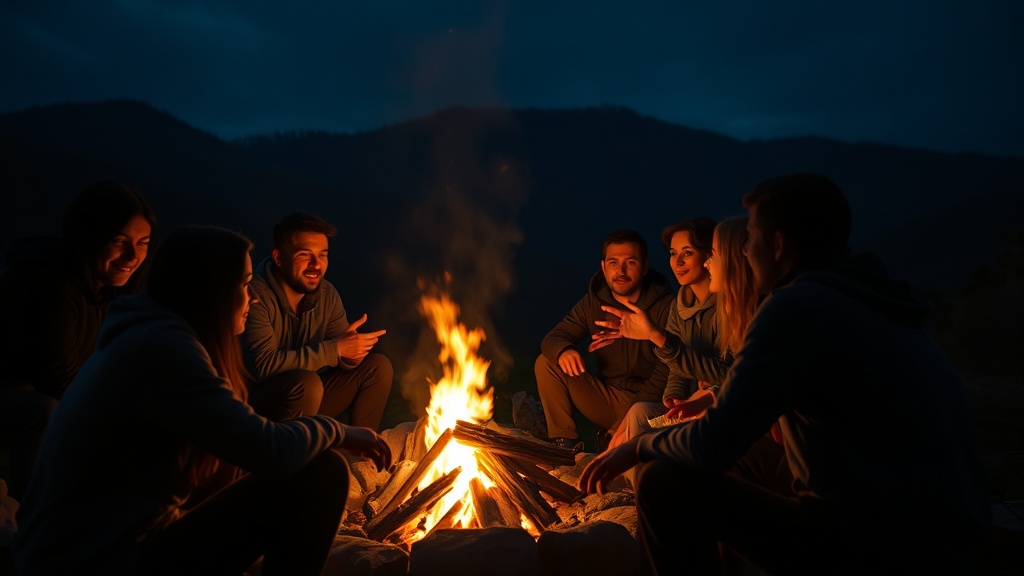
Gather round.
I taught English for twelve years, and the thing nobody tells you about middle schoolers is that they are the hardest audience on the planet. Harder than a comedy club. Harder than a boardroom. A twelve-year-old will look you dead in the eye and say "this is boring" while you're mid-sentence, and they will be right.
So when people ask me how I got good at telling stories around a campfire, I don't say "practice." I say "seventh graders." They trained me. And they were merciless about it.
Here's what I learned — from classrooms, from eight summers at Camp Lutherock, and from a few hundred fires in the hills outside Asheville — about how to actually hold a circle.
Rule one: you are not the story
The biggest mistake new storytellers make is thinking the story is about them. It's not. Even when it's YOUR story — something that happened to you on a trail or in a tent or driving home at 2 AM — the moment you start telling it, it belongs to the circle.
What that means practically: stop watching yourself tell it. Watch the listeners. Their faces will tell you everything. Are they leaning in? Speed up. Are they shifting? You lost them three sentences ago, and you need to cut to the next thing that matters.
I learned this from a kid named Marcus in my third year of teaching. I was reading a passage from Hatchet out loud and feeling pretty good about my dramatic pacing. Marcus raised his hand and said, "Mr. Washington, can you skip to the part where something happens?" He wasn't being rude. He was being honest. The story had stalled and I was the only one who didn't notice.
Start in the middle of the action
English teachers call this in medias res. I call it "don't make people sit through your preamble."
Bad opening: "So this one time, me and my buddy Jake were planning a camping trip, and we were trying to figure out where to go, and we looked at a bunch of options..."
Better opening: "Jake called me at 11 PM and said, 'There's something in the trees behind my tent and it's not a raccoon.'"
See the difference? The second one puts a question in the listener's head immediately: what was in the trees? That question is the only thing keeping them with you. Protect it. Don't answer it too early. Don't explain around it. Let it sit.
Around a fire, you have about fifteen seconds before someone checks their phone or pokes a log or starts a side conversation. Fifteen seconds. That's your window. Use it or lose the circle.
Use the fire
This is the part that separates campfire storytelling from every other kind.
You have a live element in front of you — shifting light, popping embers, wind changes. Most people ignore the fire while they talk. I lean into it.
When a log pops, I pause. I let the sound land. Then I continue quieter than before. The contrast does more work than any word I could say.
When the fire dims and faces get harder to see, I slow down. The darkness is doing half the storytelling for me. I don't fight it. I match it.
When wind pushes smoke toward someone and they shift, I use that movement: "Yeah, you'd move too if you saw what I saw next." It sounds simple. It is simple. But it stitches the real moment into the story, and suddenly the whole circle is inside it together.
Pace is everything. Volume is almost everything.
In a classroom, I learned to project. Around a fire, I learned to do the opposite.
The most powerful move in campfire storytelling is getting quieter. Not louder. Quieter. When you drop your voice, people physically lean in. Their bodies move toward you. That is attention you cannot buy with drama or volume.
I use three speeds:
- Normal pace, normal volume — for setup, context, the parts that orient people.
- Faster pace, slightly louder — for action, tension, the moments where things go wrong.
- Slow pace, very quiet — for the turn. The reveal. The part they'll remember tomorrow.
If you stay at one speed the whole time, you're a ceiling fan. Pleasant enough, easy to ignore.
Details matter, but only three of them
I used to teach my students the "three-detail rule" for descriptive writing, and it works even better out loud.
When you describe a scene, pick three specific details. Not five. Not seven. Three. And make them sensory — what you heard, what you smelled, what the air felt like on your skin.
"The trail was dark and the rocks were wet and I could hear something breathing that wasn't me."
That's three details. Dark trail. Wet rocks. Breathing. Your listener's brain fills in everything else — the trees, the cold, the fear. You don't need to describe the full scene because human imagination is better than your vocabulary. Give people just enough to build the picture themselves, and they'll build one scarier than anything you could hand them.
The pause is your best tool
New storytellers are afraid of silence. They rush to fill every gap. Around a fire, silence is not empty — it's loaded.
After a big moment, stop talking. Count to three in your head. Let the crackle of the fire and the weight of what you just said do the work. Three seconds of silence after "and the door was already open" hits harder than any sentence you could follow it with.
Doug Wood, who's been telling stories longer than I've been alive, says the key is to forget the rest of the story and make it up as you go. I half agree. I think you should know your ending cold — know exactly where you're landing — but be loose with everything in between. That looseness is what lets you pause when the moment calls for it instead of steamrolling toward a finish line.
End clean
The worst campfire stories don't end. They just... trail off. The teller runs out of steam and says "so, yeah" and everybody stares at the fire wondering if there's more.
A good ending does one of two things:
- It answers the question you opened with. What was in the trees? It was Jake's dog. Or it wasn't.
- It leaves one new question that you never answer. "I never did find out what made that sound. But I haven't camped on that ridge since."
Either way, the ending should feel like a door closing. Not a slow fade. A click.
My Camp Lutherock trick: after the last line, I don't say anything else. I just look at the fire. The silence tells the circle the story is done, and it gives the next person space to start theirs — or to sit with what they just heard.
One more thing the classroom taught me
Stories are not performances. They're gifts.
When I stood in front of thirty kids every day, the best moments weren't when I nailed a reading or delivered a perfect lesson. They were when a quiet kid in the back row said, "That story reminded me of something that happened to my grandma." That's the real thing. The story moved from me to them and became theirs.
Around a fire, the same thing happens. You tell a story, and if you did it right, someone across the circle says, "That reminds me of the time..." and now THEY'RE telling one. The fire keeps going because the stories keep going. That's the whole point.
You're not trying to be the best storyteller in the circle. You're trying to be the one who gets the circle telling stories.
That's the craft. That's the magic. And it starts the same way every good fire does — with one small spark and enough room to breathe.