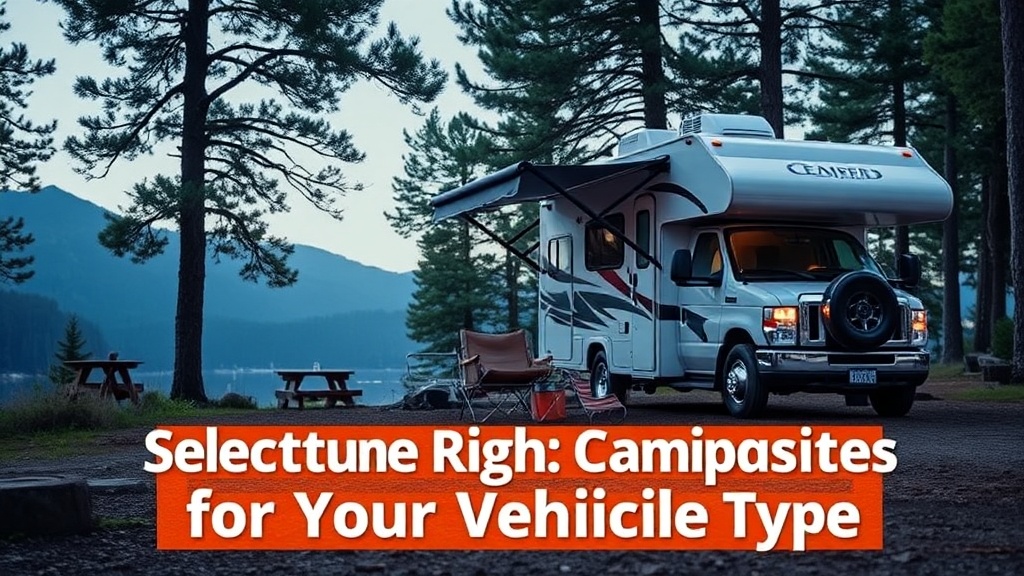
Selecting the Right Campsite for Your Vehicle Type

What determines where you can park your vehicle?
This guide covers how to choose a campsite based on your specific vehicle dimensions, weight, and mobility needs. Whether you are driving a compact SUV, a heavy Class A motorhome, or a nimble camper van, your choice of ground matters just as much as your destination. Choosing the wrong spot can lead to stuck axles, scraped side mirrors, or a very uncomfortable night's sleep. You'll learn how to match your rig to the terrain and the amenities available at different types of campgrounds.
The first thing to consider is your turning radius. I spent years watching campers try to squeeze a massive rig into a tight corner at Camp Lutherock, only to realize they couldn't back out without a spotter. If you are in a long-wheelbase vehicle, you need wide-open spaces. If you're in a small car, you can squeeze into those cozy, wooded loops that larger rigs simply can't reach. Always check the width of the entry roads before you commit to a booking. There is nothing quite as stressful as seeing a narrow, winding dirt path and realizing your rig is six inches too wide for the gap.
Weight distribution is another factor that often gets overlooked. If you're towing a heavy trailer, you need to know about the compaction of the soil. A soft, sandy site might be fine for a lightweight tent camper, but it's a nightmare for a heavy truck-and-trailer combo. You don't want to spend your morning digging your rear wheels out of a mud pit because the ground couldn't support your weight after a light drizzle. For more information on vehicle weight limits and safety, you can check the guidelines provided by the National Park Service regarding road-side safety and vehicle-specific restrictions.
How do I choose between a developed campground and boondocking?
Developed campgrounds offer a level of predictability that is hard to beat. You'll find level pads, electricity, water hookups, and often a nearby bathroom. This is the way to go if you're running a complex electrical system in a van or if you need to refill your water tanks frequently. However, these sites are often more crowded and can feel a bit more "civilized" than the rugged experience many people seek. If you're driving a rig with a large solar array, you'll want to look for sites that offer shade, or conversely, sites that are wide open to maximize your sun exposure.
Boondocking—or dispersed camping—is the complete opposite. It's free, it's wild, and it's often located on BLM (Bureau of Land Management) land. This is perfect for those who want to disconnect from the grid. But be warned: you are entirely on your own. You'll need to manage your own power, water, and waste. If you are a beginner, I'd suggest starting with a more established site before jumping into the deep end of remote camping. You can find excellent maps and regulations for public lands via the Bureau of Land Management website to ensure you're following local land use rules.
When you're looking at a map, don't just look at the location; look at the topography. A site that looks flat on a screen might have a significant slope in person. A slight incline can make a huge difference when you're trying to sleep in a bed that's tilted toward the door. If you're staying in a van, a slightly tilted floor can make your coffee spill or even make it hard to stand up comfortably. Always look for reviews that mention the "levelness" of the sites. This is a detail that most people skip, but it's one of the most important parts of a successful trip.
Which campsite type fits my specific setup?
Let's break down the common setups to see where they thrive:
- The Compact SUV/Tent Setup: Best for high-altitude, narrow-road destinations. You can reach the spots that the big rigs can't. You'll have more freedom to move, but you'll be more dependent on your gear for comfort.
- The Camper Van: The middle ground. You have more amenities than a tent, but you're still relatively mobile. You can handle most standard campground roads, but avoid the ultra-tight, unmaintained forest service roads.
- The Class A Motorhome: This is a rolling house. You need wide, paved, or well-graded gravel roads. You'll love the amenities of full-service RV parks, but your options for "wild" camping are much more limited due to your size and weight.
- The Overlanding Rig: Built for the dirt. If you have a high-clearance 4x4, you can venture much further into the backcountry. You aren't limited by paved roads, but you do need to be mindful of your fuel and water capacity.
It's also worth considering your connectivity needs. If you're traveling for work or need to check in with family, look for campgrounds with cell service or even Wi-Fi. If you're looking for a total digital detox, aim for those remote spots where the only thing you'll hear is the wind in the trees. I remember a trip where I thought I'd have a signal, only to find out that the giant granite wall behind the camp was basically a giant signal shield. Always have a backup plan for communication.
Lastly, think about your "arrival" time. If you're arriving at a campground after dark, you want a site that is easy to handle. Maneuvering a vehicle through a dark, wooded site with limited visibility is a recipe for a scratched fender or a broken headlight. If you're a night owl or a late arriver, look for campgrounds with clear signage and well-lit entryways. It makes the transition from the road to the campsite much smoother and less stressful.