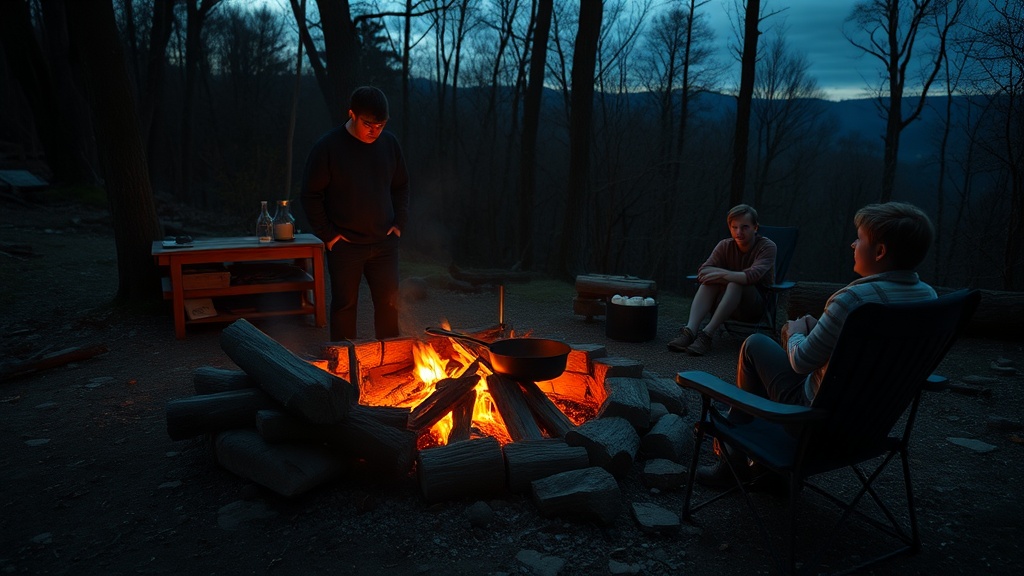
The 20-Minute Campfire Start Routine I Use Before Every Fire Night

Gather round.
I’ve done enough campfires to know this: almost every disaster starts before the first log even catches.
Not a broken stove. Not a missing ingredient. A fire gone wrong starts with the first 20 minutes, and when those minutes are sloppy, everyone in the circle pays for it.
So here’s the routine I use before every outdoor fire night, from a five-person backyard get-together to a weekend trip where everyone is sleep-deprived and already talking louder than everyone should be.
It sounds almost too organized for people who say they “just want vibes.” It is organized. And it works.
The 20-minute rule
I do this for one reason: I want the actual evening to happen.
In my head, the rule is simple:
- minutes 0-5: legal check + site scan
- minutes 5-10: materials check + fire layout
- minutes 10-15: ignition and feed sequence
- minutes 15-20: safety radius + story cue
If this sounds rigid, good. It’s easier than arguing at 9 PM when the fire is smoking and the kids are already talking louder than everyone should be.
Minutes 0-5: I ask two hard questions
First I ask myself:
- Am I legal to build fire here right now?
- Can I run this fire safely for the people I’m responsible for tonight?
The U.S. Park Service says every park has local rules for where, when, and how you can build a fire, and that they can change with wind, dry spells, and burn bans. That means even if you built here last month, you still check first. I check signs, then the ranger board, then the reservation notes. If I can’t confirm, I don’t build.
I also check wind direction and canopy. If we’re in tall dry grass, I push the ring farther from camp chairs and gear. If there’s overhead branch litter, I clear it. Not perfect; just safer.
Minutes 5-10: materials, only once, in one place
I put everything into the same lane: tools in one hand basket, kindling in one basket, wood in one lane. The circle gets one person assigned to pass tools, so nobody disappears to hunt for tongs.
My starting kit is boring and never changes:
- two pairs of heat-safe gloves
- long tongs and poker
- one small water bucket with lid
- one shovel or flat tool for ash control
- match/light source
- two to three pounds of dry kindling
- 3-4 dry split pieces for ignition stack
- one flat fire ring or pit with clearance already marked
If I’m taking a car trip, I keep this kit near the front passenger-side hatch so unloading is one run, not a scavenger hunt.
One personal rule from camp counselor years: I never start with wet, bark-heavy wood or bark-heavy splits unless I’m only trying to build smoke on purpose. Bark burns badly and chokes the fire. People hate choking smoke the same way they hate the 5-minute preamble before a great story.
Minutes 10-15: build with a reason, not a pile
I stack larger pieces in a simple lattice, not a perfect cone. I leave breathing room.
Then I lay kindling and small splits in the pockets where air can move. For starters I prefer small, reliable ignition over chemistry-heavy stuff. Chemical accelerants are for when logistics fail, not for every fire.
My sequence is:
- light tinder and the smallest kindling first,
- feed gradually,
- add two larger splits and wait,
- add one split if heat is clear,
- pause and check draft before adding anything more.
If I’m cooking later, I leave at least two open sides of coals open so I can set a pan safely later.
Minutes 15-20: safety radius + social cue
Once flame has shape, I walk the circle distance.
I use the old 15-foot rule as a baseline: tents, vehicles, chairs with blankets, and anything in synthetic material move out of it. I mention one rule out loud: “if your shoe or sleeve feels warm when you’re not expecting it, you move one foot back.”
Then I do one of two “circle cues.”
For families: “If everyone is still standing, we are not ready to sit.”
For older crews: I set one glass jar of water on the edge and say, “that’s our extinction plan, keep it visible.”
No one remembers rules as well as they remember a symbol.
The two callouts everyone should have memorized
My whole routine sits on two truths.
And this one:
I once watched a “perfect” evening turn sour because everyone assumed someone else had handled cleanup. Nobody wanted to say, “The fire is still hot.” So we now say it out loud. Everyone hears it.
Why this routine changed everything for me
Two years ago, I had a Saturday where everything about the plan felt modern and fast and confident, and by 9 PM we had three adults in competing moods and two kids in one of their dangerous “not listening, still close” modes.
The fire wasn’t the problem.
The routine was missing.
This routine gives us three things I can measure:
- fewer arguments over chores,
- fewer burnt pieces of food,
- fewer people wandering into ember edges.
And yes, that’s not glamorous, but this is where good campfire culture is built.
What I would do differently from “spontaneous” campfire rules
There’s a myth that real campfire scenes only happen when nothing is planned. That’s fair for poetry, not for people.
My unpopular opinion: a little structure is the only thing that protects spontaneity.
You can still throw your weird playlist on and tell that long family story at 9:10 PM. The structure just gets you to 9:10 with everyone still there and not in danger.
Build this into your next outing
You won’t need permission from your crew to run this routine. You just need consent to skip chaos.
Print this on a page. Put it on your phone. Teach one child to be “materials marshal,” one teen to be “coals watch,” one adult to be “hydration lead.”
It sounds like a job, not a ritual. Then watch it feel like one.
When we stop apologizing for preparation, the first real storytelling starts sooner.
Gather round.