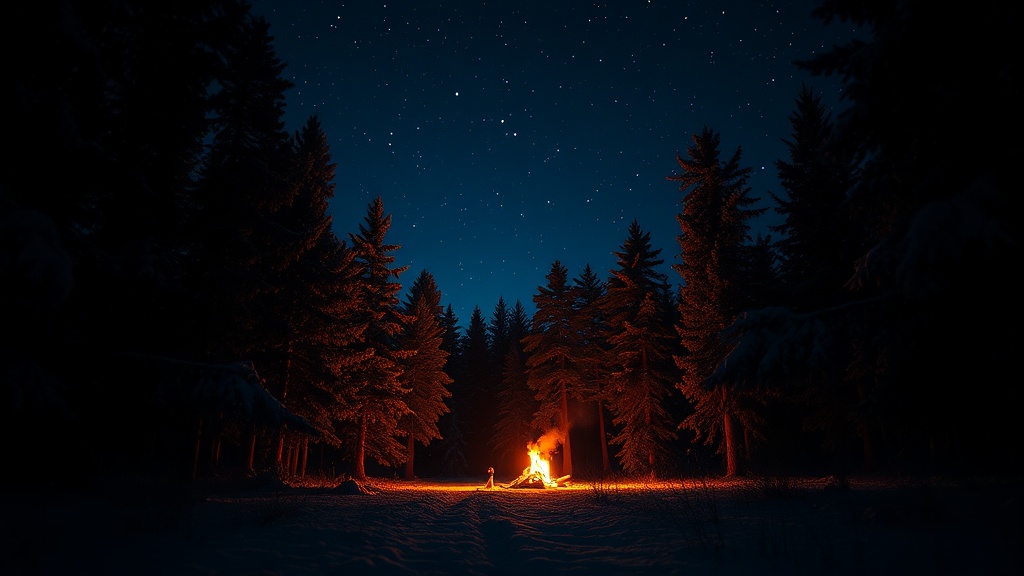
The Hiker on the Ridge: A Winter Campfire Ghost Story

Gather round, y'all. The fire's good and low, and February nights are the longest of the year.
Age Rating: Teens and Adults
Best Told: On a cold night when the wind is rattling the trees
Reading Time: About 8 minutes
There's a stretch of the Appalachian Trail up near Roan Mountain where the trees thin out and you can see for miles. In the summer it's all green rolling hills and wildflowers. But in the winter, when the leaves are gone and the wind comes down from Canada with nothing to stop it, that ridge feels like the edge of the world.
My friend Marcus told me this story. He heard it from an old trail maintainer named Bill who'd been working that section of the AT for forty years. Bill said it happened to him in February of 1987, but he'd never told anyone except Marcus, and Marcus only told me because we were sitting around a fire with whiskey in our cups and he needed to get it out.
Bill was doing a solo maintenance run that February. The Park Service needed someone to check the shelters and clear any blowdowns before the thru-hikers started coming through in March. He'd been on the trail for three days, working his way north from Carver's Gap, and he planned to spend the night at the Overmountain Shelter—a big old barn converted for hikers, sitting right on the ridge with views that'll make you believe in God or forget He exists, depending on the weather.
The day had been clear but bitter cold, temperature dropping into the teens as the sun went down. Bill got to the shelter just before dark, built a small fire in the stone pit out front, and settled in with his dinner. He was alone—nobody else was crazy enough to be out on the AT in February—and that suited him fine. He liked the quiet.
He'd been sitting there for maybe an hour, watching the fire and the stars, when he heard footsteps on the trail.
Now, Bill knew every sound those woods made. He knew the difference between a deer and a bear, between wind in the rhododendron and a person walking. These were boots. Heavy boots. Coming up the trail from the south, moving slow but steady.
Bill thought it was odd, but not impossible. Sometimes locals used the trail for shortcuts, especially if they were hunting. He called out a greeting, figuring whoever it was might want to warm up by the fire.
The footsteps stopped.
Bill waited. He called out again. No answer.
He grabbed his headlamp and walked down the trail a ways, thinking maybe someone was hurt or lost. The beam of his light cut through the dark, finding nothing but empty trail, frozen mud, the bare branches of oak and hickory. He walked fifty yards down to where the trail curved around a rock outcrop. Nothing. No tracks in the frozen ground. No sign anyone had been there at all.
Bill was a practical man. He figured he'd imagined it, or maybe it was sound carrying weird in the cold air. He went back to the shelter, stoked the fire, and tried to shake off the feeling that someone was watching him from the tree line.
He didn't sleep much that night.
The next morning, he packed up early and started north toward the next shelter. It was a ten-mile stretch through some of the most exposed terrain on the whole AT—just you and the wind and the sky. The day was clear and cold, and Bill made good time.
Around midday, he stopped for lunch on a rocky outcrop with a view of the valleys below. He was sitting there eating peanut butter crackers when he heard it again.
Footsteps. Heavy boots on frozen ground.
Coming from behind him, from the south, moving at a steady pace like someone on a long hike.
Bill stood up and looked back along the trail. Nothing. Just the white blaze marks on the trees and the empty path winding through the winter woods. The footsteps grew closer—he could hear them clearly now, crunching through the leaf litter, the rhythm of a determined walker.
He called out. "Hello? Trail maintainer up here. You okay?"
The footsteps stopped.
Bill waited. His breath fogged in the cold air. He could hear his own heartbeat in his ears.
Then the footsteps started again. But now they were coming from the other direction—from the north, ahead of him on the trail. Same heavy boots, same steady pace. Like someone was walking toward him from both directions at once.
Bill grabbed his pack and started moving. He walked fast, not running—that would be admitting something was wrong—but fast enough that his lungs burned in the cold air. He didn't stop for three miles, not until he reached the next shelter and found it occupied by a couple of winter hikers who looked at him like he was crazy when he burst through the door white-faced and sweating despite the freezing temperatures.
He spent the night with them, grateful for their company, and he never heard the footsteps again.
But here's the part that keeps me up at night.
Bill told Marcus that later that spring, when the thru-hikers started coming through, he met a young woman at the trailhead who was asking about her brother. He'd gone missing on the AT the previous February, somewhere near Roan Mountain. He'd been an experienced hiker, she said. Knew the trail well. But he'd gone out for a weekend section hike and never come back.
Search and rescue had looked for weeks, she said. Found his car at Carver's Gap. Found his pack three miles up the trail, sitting neat as you please beside a rock outcrop with his lunch half-eaten. But never found him. Not a trace.
Bill asked her what her brother looked like. She pulled out a photograph.
Heavy boots, she said. He always wore heavy boots.
Bill never worked that section of trail again. Retired the next year. Moved to Florida, where it's warm and flat and you can see everything coming.
Marcus asked him once, near the end, if he thought it was the missing hiker he'd heard. Bill just looked at him for a long time.
"I don't know what I heard," he finally said. "But I know this—February on that ridge belongs to something that walks heavy and doesn't want company. And whatever it is, it's still up there, walking the trail, waiting for someone to walk slow enough to catch up."
Telling Tips:
When you get to the part where the footsteps switch directions, pause. Let that sink in. Look around the fire at your listeners, make eye contact. The silence is your friend here.
When you say "heavy boots," say it like you're hearing them right now. Let your voice drop lower. Make them feel the weight of each step.
And at the end, when you're done, don't say anything for a few seconds. Let the fire pop. Let them hear the night. That's the scary part.
Sweet dreams, y'all.