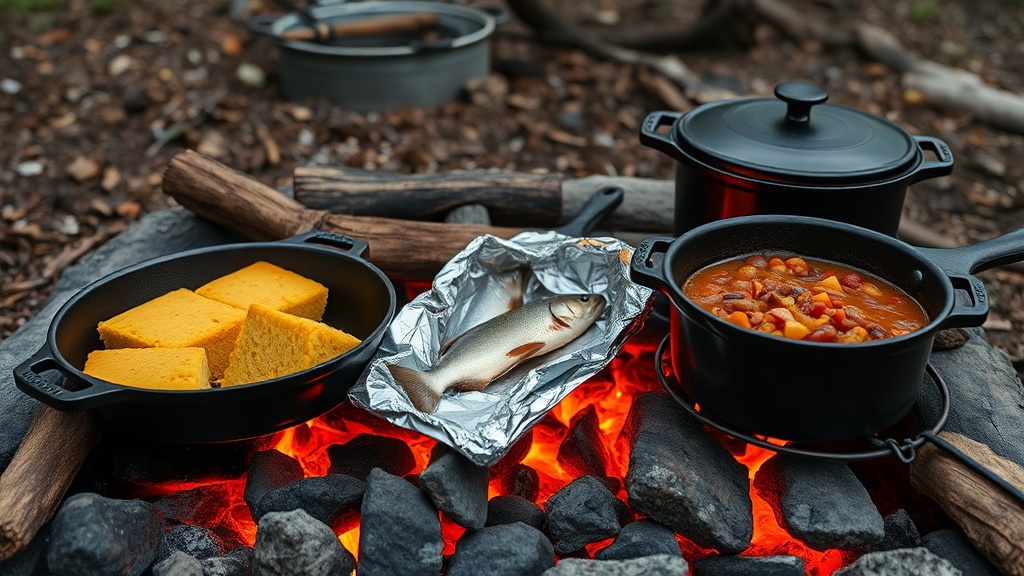
The Recipes That Remember Them: Three Women, Three Fires, Three Dishes That Belong in Your Rotation

International Women's Day is March 8th, and I've been sitting with this for a few weeks now, trying to figure out what I actually want to say that I haven't already said.
I've written about the women who kept campfire culture alive. I've written about the women who taught me the fire itself. But there's a third piece I keep circling back to, and it's the most practical one: what they actually cooked.
Not in restaurants. Not in test kitchens. Over fire, in cast iron, in foil, on sticks, in the dark, feeding people who needed to be fed.
Here are three women from my life — and three recipes they taught me, directly or indirectly, that I still cook today. March is the month people start building fires again after winter. These are the dishes worth cooking around those first spring fires.
Mattie Washington's Cast Iron Cornbread (Coals Method)
My grandmother Mattie didn't camp. Let me be clear about that. She thought sleeping on the ground was a personal failing. But she kept a cast iron skillet that she'd had since the 1960s, and at every family reunion in the backyard in Asheville, she made cornbread in that skillet over the grill's indirect heat — and later, when my dad got a proper fire pit, directly in the coals. She called it "real cornbread" to distinguish it from what she considered the abomination of boxed mix.
She's been gone since 2018. I have the skillet.
The Method
The thing about cooking cornbread over coals is you're running two heat sources: the coals below and the lid above. You need to think about it like a small oven.
Build your fire down to a solid coal bed — no flames, just orange-gray coals. You want consistent, radiating heat, not the chaos of active flame. This takes about 45 minutes from match to ready coals if you're using hardwood. If you want to understand the architecture of a fire that will actually hold steady, read about thinking in layers.
Ingredients
- 1½ cups stone-ground cornmeal (yellow, not white — Mattie was very specific)
- ½ cup all-purpose flour
- 1 tablespoon baking powder
- 1 teaspoon salt
- 1 tablespoon sugar (Mattie added this reluctantly; she believed sweet cornbread was a Northern affectation, but she admitted it helped with the browning)
- 2 eggs, beaten
- 1 cup buttermilk
- ¼ cup bacon drippings (or vegetable oil if you must)
Process
Preheat your 10-inch cast iron skillet directly on the coals for about 5 minutes. Add a tablespoon of bacon drippings and let it get hot — you want it shimmering before the batter goes in.
Mix your dry ingredients. Mix your wet ingredients separately. Combine them until just incorporated — do not overmix, do not try to make it smooth. Lumps are correct.
Pour batter into the hot skillet. You should hear it sizzle. That sound is your first sign you did it right.
Cover tightly with foil (or a tight-fitting lid if you have a camp dutch oven lid that fits). Shovel a layer of coals on top — you want heat from above and below. Cook 20-25 minutes. Cornbread is done when a knife in the center comes out clean and the edges pull slightly from the pan.
Let it rest 5 minutes before you cut it. Mattie would not serve cornbread that hadn't rested.
What I learned from her: Patience with fire is the same as patience with bread. You don't rush either one.
Rosa Delgado's Foil Packet Trout with Herbs and Lemon
Rosa was a fellow counselor at Camp Lutherock the summer I was 23 — my second year there, her fourth. She grew up outside Santa Fe, and she cooked like she'd learned it from the land itself. Quiet, efficient, no waste. She could take a fish we'd just pulled from the lake and have it over the fire in fifteen minutes with three ingredients and no drama.
I watched her make this for a group of homesick 12-year-olds one night in July, and I have made some version of it hundreds of times since. Rosa's philosophy: the fire should do the work, not you.
She now runs a wilderness cooking program in New Mexico. I think about her every time I open a foil packet and the steam hits me.
The Method
This works for trout, bass, salmon, walleye — any fillet or small whole fish. I'll give it to you for whole trout, which is how Rosa made it, but fillets work too (cut the time by about a third).
Ingredients (per person)
- 1 whole trout, cleaned (10-12 oz)
- 4-5 sprigs fresh thyme or rosemary — or both
- 3 thin slices lemon
- 2 garlic cloves, smashed
- 1 tablespoon butter, cut into small pats
- Salt and black pepper
- Optional: a small handful of cherry tomatoes, which soften into a sauce around the fish
Process
Tear a piece of heavy-duty aluminum foil large enough to fold over the fish twice with room to seal. This is important — a tight seal keeps steam in, and steam is the mechanism here.
Season the fish cavity and outside with salt and pepper. Stuff the cavity with thyme, lemon slices, and garlic. Lay the fish in the center of the foil. Add butter pats on top. Wrap tightly, folding the edges over twice to seal.
Place the packet directly on medium coals — not the hottest part of your fire, off to the side where coals have settled to an even gray. Cook 15-18 minutes for a whole fish this size. The real doneness test: open a corner and check that the flesh flakes easily and is opaque all the way through — no translucent pink at the center. That's what you're looking for.
Rosa's rough field indicator: pick up the packet carefully with tongs. If it feels firm and holds its shape, it's probably ready to open. If it's still soft and floppy, give it 5 more minutes and check the flesh again. The packet feel is a shortcut to know when to bother; the flaking flesh is the actual confirmation.
Open the packet at the table. The steam that comes out is half the experience.
What I learned from her: The best outdoor cooking doesn't fight the environment. It uses it.
Keisha's Low-and-Slow Fire Chili
My wife Keisha grew up in Charlotte. Apartment kid. No camping, no bonfires, no fires of any kind really. When we started dating and I brought her to the fire pit for the first time, she was politely tolerant in the way that someone is politely tolerant of a hobby they don't yet understand.
That lasted about two years. Then she made this chili.
I'm not entirely sure what flipped the switch, but somewhere around 2019 she started reading about low-and-slow campfire cooking, and one October weekend she announced she was going to make chili in the dutch oven over the fire pit. She had notes. She had a thermometer. She approached it the way she approaches a difficult patient case: with curiosity and a plan.
The chili she made that night was better than anything I'd made in fifteen years of cooking outdoors. I will not pretend otherwise.
She's made it thirty or forty times since. It's the dish that converted her from fire-tolerant to fire-devoted. Every fall and winter, our neighbors appear when they smell it.
I'm giving you Keisha's recipe, not mine. She reviewed this section. She says you're welcome.
The Method
This requires a 6-quart cast iron dutch oven and a fire with a good coal bed. You're cooking at around 350°F — low and slow, two to two-and-a-half hours. The long cook is what builds the depth. Don't rush it.
Ingredients
- 2 lbs ground beef (80/20) or a mix of ground beef and cubed chuck
- 1 large onion, diced
- 1 green bell pepper, diced
- 4 garlic cloves, minced
- 2 cans (15 oz) fire-roasted diced tomatoes — the fire-roasted variety specifically
- 1 can (15 oz) kidney beans, drained
- 1 can (15 oz) black beans, drained
- 2 tablespoons chili powder
- 1 tablespoon cumin
- 1 teaspoon smoked paprika
- 1 teaspoon oregano
- ½ teaspoon cayenne (more if you want it)
- Salt and pepper
- 1 bottle dark beer (she uses a porter or stout — the bitterness balances the tomatoes)
- 2 tablespoons masa harina (dried nixtamalized corn flour — find it in the Latin foods aisle; not the same as cornmeal or regular corn flour), stirred into ¼ cup cold water — Keisha's thickening move
Process
Get your dutch oven hot over direct flame or fresh coals. Brown the meat in batches — don't crowd it, let it actually brown. Remove and set aside. Sauté onion and pepper until soft, about 8 minutes. Add garlic for another minute.
Add the chili powder, cumin, paprika, oregano, and cayenne directly to the vegetables and let the spices bloom for 60 seconds — this matters, it changes the flavor.
Return the meat. Add tomatoes, beans, and beer. Stir to combine. Cover.
Now move to low-and-slow territory. You want coals beneath and some on top of the lid — Dutch oven cooking, old school. The goal is a gentle, steady simmer, not a rolling boil. Adjust by pulling coals away if it gets too hot.
Cook 1.5 to 2 hours, checking and stirring every 30 minutes. In the last 15 minutes, stir in the masa slurry to thicken. Taste and adjust salt.
Serve with cornbread. (Specifically, Mattie's cornbread.)
What I learned from her: Beginner's mind is an asset. Sometimes the person who just picked it up sees it more clearly than the person who's done it for thirty years.
A Note Before You Cook
I've written about women and fire before on this blog — about the ones who kept the traditions alive, about the ones who taught me the craft. But I keep coming back to the recipes because that's where the knowledge actually lives. Skills transfer through doing. The women who shaped me as a fire cook didn't give me philosophy — they gave me technique, and the technique carries the philosophy inside it.
Mattie's patience with the cornbread. Rosa's trust in the fire. Keisha's rigor and curiosity. I cook with all three of them every time I light a match.
Spring fires start this month. Make one of these around yours.
Campfire Stories goes up in smoke every week or so. If this landed for you, share it with someone who could use a reason to be outside.