The Women Who Taught Me Everything I Know About Fire
International Women's Day is March 8th. Still technically winter — the equinox is twelve days out — but the ground is sending signals, and the instinct to sit outside and light something has already kicked in. I've been thinking about what I want to say this week, and I keep coming back to the same place.
Every fire I know how to build, I trace back to women.
Not metaphorically. Literally. The actual physical knowledge — where to find dry wood after a rain, how to read a bed of coals, when a fire is ready to cook on versus just ready to look at — that knowledge has women's fingerprints all over it. And the other thing, the thing that makes campfire more than just controlled combustion? The stories? That's almost entirely women, at least in my experience.
Let me tell you about a few of them.
My Grandmother, Ruth Washington
My grandmother didn't camp. Let me be clear about that. Ruth Washington was a woman who grew up in rural Georgia in the 1930s, and the idea that sleeping outside voluntarily was some kind of pleasure activity was, as she put it, "a very specific kind of foolishness." She had no patience for it.
But she could work a fire.
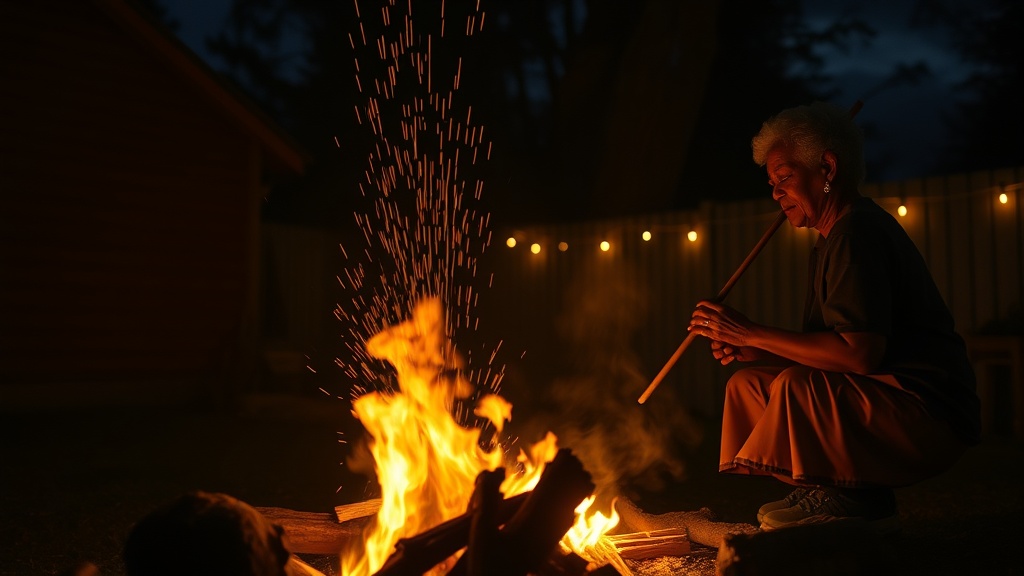
The pit in her backyard in Asheville was the center of everything — every holiday, every reunion, every random Saturday. She controlled that fire the way a conductor controls an orchestra. She knew what actually holds a fire together — she didn't ask for help, didn't consult anyone. She built it, managed it, and held court around it until she decided it was time to go inside.
And she told stories.
Not ghost stories, exactly, though some of them were scary in ways that have stayed with me for forty years. Stories about real people. About her mother and grandmother. About what it cost Black families in the South to simply exist, and how they found ways to laugh anyway. About a cousin who did something so embarrassing at a church picnic in 1962 that I still can't think about it without laughing, and she's been gone twelve years.
I asked her once why she always told stories at the fire. She looked at me like I'd asked why she breathed. "Because that's where they belong," she said. "Fire keeps stories honest."
I've thought about that for thirty years. I think I'm still unpacking it.
The Women at Camp Lutherock
I spent eight summers as a counselor at Camp Lutherock up in the Blue Ridge Mountains. I've told this story before, but what I don't always mention is who actually taught me to run Campfire Stories — the Friday night session that eventually became this blog's namesake. Women have always been the keepers of this tradition, and Gloria Hines was one of the best I've known.
Her name was Gloria Hines. Senior counselor, fifteen years at that camp, a woman in her late forties who had the patience of deep water and a voice that could carry clean across a lake. She was the one who pulled me aside during my first summer, when I was twenty-three and thought I knew how to run a campfire session because I'd been to plenty of them.
"You're entertaining," she told me. "That's not the same as storytelling."
Then she showed me. She sat down with a group of twelve-year-olds who'd had a rough week — homesick, sunburned, all of it — and she told a story about a girl who was afraid of the dark. But she told it slowly. She left space in it. She let the fire crackle into the silence. By the end, those kids weren't just listening. They were inside it. Two of them cried. Not sad tears — the kind you cry when something true happens.
I spent the next seven summers studying how she did that. I still don't think I've fully figured it out.
There was also Maya — I won't give her last name because she's intensely private — who taught me more about fire building than anyone else in my life, period. Maya was a wilderness education specialist who could build a fire in wet conditions that would make you question everything you thought you knew. She taught me the inner-bark method for finding dry tinder after rain. She taught me to read smoke color. She had more practical fire knowledge in her little finger than most YouTube survival channels have in their entire catalog.
She also told the best ghost stories I've ever heard. Which seems like a contradiction until you realize it isn't — the person who understands fire most intimately is exactly the person who knows how to use the dark most effectively.
Keisha, Who Will Absolutely Read This
My wife Keisha has been listening to me talk about fire for twenty years. She's a nurse practitioner, which means her relationship with the outdoors is complicated by the fact that she spends all day watching what happens to human bodies when things go wrong — and some of those things involve the outdoors going wrong. She's not a camper. She'll come outside to the fire pit, but she's usually got a book, usually got a blanket, and she considers my enthusiasm for kindling arrangement to be one of my more eccentric qualities.
But here's the thing about Keisha around a campfire: she tells different stories than I do. I lean into drama, into mystery, into the classic beats of a ghost story or a funny story with a clean landing. Keisha tells true stories. Stories about patients she can't quite let go of. Stories about her own childhood in Durham. Stories that don't have neat endings because real things don't.
Our kids have grown up listening to both of us. Jaylen, who's fifteen, tells stories more like me — loves the craft, the architecture. Nia, who's eleven, tells stories more like Keisha — just goes straight to the heart of it, zero hesitation, doesn't care about the setup, just says the thing that's true.
Nia is going to be a better storyteller than I am. I've known this for two years. I'm at peace with it.
What Women Bring to the Fire That Deserves to Be Named
I want to be careful here because I'm generalizing, and I know I'm generalizing. But I've sat around hundreds of fires with hundreds of people, and I've noticed something.
Women, in my experience, are more willing to let silence into a story. They're more comfortable with the part before the point. They trust the listener more.
Men — and I include myself — often tell stories like we're trying to get somewhere. There's a destination. We're working toward the punch line, the revelation, the moment where we've won the telling. Women I've sat around fires with tend to trust that the journey is the story. They know the fire will hold the room. They don't feel like they have to.
This is not a universal truth. I know men who tell stories the slow way, and I know women who can drive a narrative to its conclusion like they're running a freight train. But as a pattern, as something I've observed sitting outside 200 nights a year?
I think it comes from a different relationship with oral tradition. Women have been the keepers of story in most cultures I know anything about — not because they were assigned the role, but because they held onto it when it mattered. The stories that survived are often the ones women refused to let die. My grandmother's stories exist because she told them again and again. Gloria Hines's teaching exists in every campfire session I've run. Maya's knowledge is in my hands every time I reach for dry tinder in wet conditions.
This is the fire that doesn't go out.
What I Want You to Do This Weekend
International Women's Day is Sunday. March 8th. Spring is less than two weeks away.
Here's what I want you to do if you have a fire pit, or a backyard, or even a fireplace: invite someone over. Or just go to your fire with the women in your life who have stories you haven't heard yet — or stories you should hear again.
Ask your grandmother about the fires she remembers. Ask your mother what stories her mother told her. Ask your daughter what story she'd tell if she were in charge of the fire tonight.
Then shut up and listen.
The fire will hold the room. It's been doing that for 400,000 years. It knows what to do.
You just have to let the right voices into the circle.
That's it for this week. Light it up for the women who taught you something — around a fire or otherwise.